


A Good Chinese Name: The Invisible Passport for Foreign Firms Cracking the China Market
- ExpertinChina
- Nov 24, 2025
- 4 min read
Updated: Dec 29, 2025
INTRODUCTION – THREE CHARACTERS THAT OPEN A BILLION DOORS
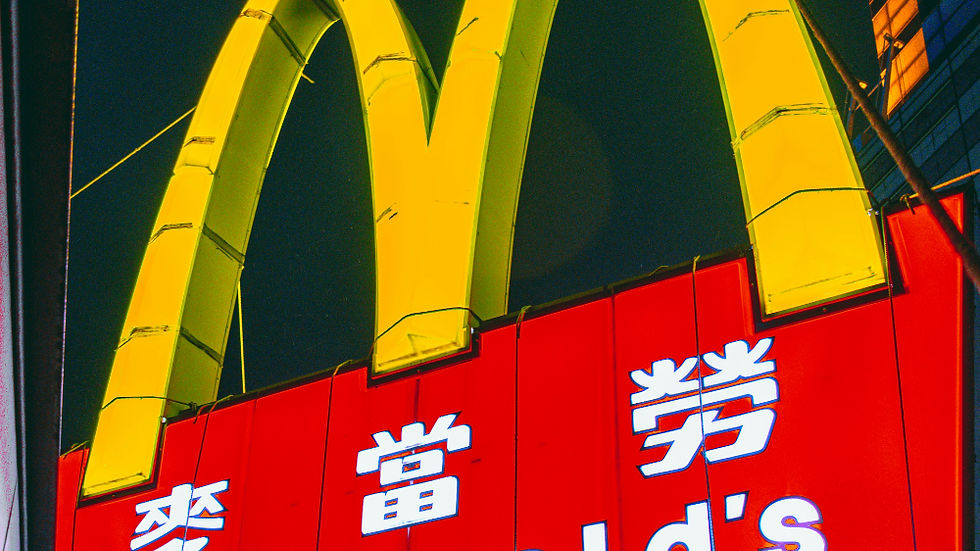
When McDonald’s quietly re-registered its China master franchise as “金拱门 (Jīn Gǒng Mén)” in 2017, social media erupted: “Sounds like a steel-furniture store!” Within hours, the company had to clarify that restaurants would still say “麦当劳.” This episode became a meme, but it highlighted a serious point: in China, your Chinese name is the first gatekeeper—legally, culturally, and commercially.
This post explains, in eight compact lessons, why a three-character string is now as critical as your product specs or tariff code, and how to avoid becoming the next punchline.
1. TRANSLATION IS DEAD; TRANSCREATION RULES
The old playbook involved copying the sound. For example, “Bing” became “必 应” bì yìng – “must answer.” The problem? It’s meaningless, unprotectable, and often ridiculed. The new playbook involves:
Sound bridge – Keep a phonetic echo (BMW “宝马 Bǎo mǎ” ≈ Bao).
Sense gift – Load positive imagery (宝 = precious, 马 = horse = speed).
Story space – Let consumers finish the myth.
Names that tick all three boxes achieve “transcreation”: phonetically familiar, semantically native, and legally ownable. Fail one filter, and you’re fighting uphill for a decade.
2. LEGAL REALITY – CHINA IS FIRST-TO-FILE, FIRST-TO-FIGHT
Two separate universes govern you:
SAMR – Approves company names.
CNIPA – Grants trademarks.
Clearance in Universe #1 does not protect you in Universe #2. If a Guangdong designer registers your beautiful Chinese characters in Class 25 (apparel) while you file only Class 9 (software), he can shut your Tmall store tomorrow.
Rules of Thumb:
File trademarks before you announce the Chinese name.
Register in both Latin and Chinese characters; courts favor the mark that proves earlier use in China, not earlier fame abroad.
Avoid national words—“中国, 中华, 国际”—unless you enjoy six-month State-Council delays.
3. CULTURAL MINEFIELDS – A CRASH COURSE IN FOUR PITFALLS
Dialect bombs – Coca-Cola sounds fine in Mandarin but near-obscene in Min dialect. Test in four major topolects.
Symbolic overload – Black & Decker’s first pick “黑得 (hēi dé)” suggested black-hearted; a switch to “百得 (bǎi dé) – hundred gains” fixed it.
Numerology – The number 4 (四) is death; 8 is prosperity. LinkedIn paid extra for Weibo handles with 8 when launching “领英 (Lǐng Yīng)”.
Political taboo – Avoid characters used in current Party slogans unless you want your Weibo account suspended for “misleading association.”
4. CONSUMER PSYCHOLOGY – WHY SHORT NAMES WIN
Neuro-marketing studies (Tencent & Nielsen, 2022) show hanzi recognition occurs in 180 ms versus 320 ms for Latin strings. After four characters, recall drops by 34%. Three-character names also dominate voice search: 62% of smart-speaker queries for foreign brands use the Chinese name, and click-through doubles when the hanzi spoken matches the official one.
Examples of Ruthless Compression:
Haribo → “哈瑞宝 (hā ruì bǎo)”.
L’Oréal → “欧莱雅 (ōu lái yǎ)”.
Thermo Fisher → “赛默飞 (sài mò fēi)”.
If a Chinese taxi driver can’t repeat it after one try, it’s too long.
5. DIGITAL AMPLIFICATION – IF IT CAN’T BE TYPED, IT DOESN’T EXIST
Pinyin autocomplete – 1.4 billion phones use QWERTY-to-hanzi conversion. Rare characters never surface. Blackberry’s “黑莓 (hēi méi)” ranks inside the top 1,200 characters = first-page suggestion.
Hashtag real estate – Weibo hashtags run without spaces. Red Bull’s “红牛 (hóng niú)” burns only two characters, leaving 18 for campaign copy.
Sticker culture – “宝马” literally paints a treasure horse; NetEase sells 120k paid chat stickers of horse-shaped BMWs—free UGC you can’t buy.
6. INTERNAL ADOPTION – WHEN EVEN THE CEO NEEDS A NAME
At the 2025 CIIE, two-thirds of Fortune-500 bosses wore Chinese-name badges. The benefits include:
Humanizing distant leadership (Auchan saw a 25% staff-retention lift).
Speeding crisis communications; an apology signed “卫思哲 (Wèi Sī Zhé)” feels humbler than “Xavier Moreno.”
Shielding privacy; legal filings can list the alias.
7. METRICS – WHAT “GOOD” LOOKS LIKE THREE YEARS LATER

8. STRATEGIC PLANNING – THE NAME AS NON-NEGOTIABLE INFRASTRUCTURE
China is no longer an emerging sidebar; it is often the profit engine that keeps global earnings alive. In that context, treating a Chinese name as a “marketing nice-to-have” is like erecting a US$500 million semiconductor fab and forgetting to put a Chinese sign on the gate. A well-engineered name compresses trust, legal shield, SEO juice, and cultural charisma into three characters that can be typed in 180 milliseconds. It is the smallest yet highest-leverage asset a foreign company will ever own.
So before you book the launch venue in Shanghai Center, ask yourself: can a Chinese taxi driver pronounce my Chinese name correctly after one sentence of explanation? If the answer is no, go back to the whiteboard. Because in the world’s biggest consumer market, the gatekeepers are not customs officers at Pudong Airport—they are 1.4 billion tongues that will either adopt, adapt, or assassinate your brand with a single syllable. Choose wisely, trademark early, and remember: in China, you don’t name the business; the name becomes the business.
HAVEN'T YOU FINALIZED THE CHINESE COMPANY NAME YET?
We assist over 500 foreign companies in completing company registration, trademark protection, and naming compliance in China. Contact our experts for a free diagnosis now to avoid spending six months starting over again. Email: expertinchina@gomaxgroup.com


Comments